Acura MDX SH-AWD Supercar

Acura MDX SH-AWD supercar with 3.7-liter, SOHC, VTEC(R) V-6 engine has 300 HP @ 6000rpm. This superar makes as much power as some competitive V-8s, yet delivers ultra-low emissions and excellent fuel economy. Inside the 7-passenger interior, the MDX offers thoughtful luxury and an unmatched range of advanced available technologies.

(From Acura Press Release)The original Acura(R) MDX(R), produced from 2001 to 2006 model years, broke new ground in the emerging luxury SUV segment. Now, the all-new 2007 MDX takes its predecessor's best qualities and radically expands them, pushing performance and sophistication in the luxury SUV segment to new levels. Benchmarked against some of the best performance SUVs in the world and tuned on the Nurburgring racetrack in Germany, the new MDX clearly establishes itself as a driver's SUV. Outfitted with Acura's tenacious Super-Handling All-Wheel Drive(TM) (SH-AWD(TM)) system and an available sport package with Active Damper System, the MDX yields a combination of handling and comfort that is truly on the cutting edge.
The 2007 MDX is equally daring in its styling and thorough in its safety and environmental responsibilities. Included as standard equipment is the largest array of passive safety features in Acura history. The MDX's class-leading 300-hp VTEC(TM) V-6 makes as much power as some competitive V-8s, yet delivers ultra-low emissions and excellent fuel economy. Inside the 7-passenger interior, the MDX offers thoughtful luxury and an unmatched range of advanced available technologies, including the Acura Navigation System and AcuraLink(TM) Satellite Communication System with real-time traffic and a spectacular 10-speaker Acura/ELS Surround(TM) Premium Sound System.
Altogether, the all-new 2007 MDX embodies Acura's commitment to performance, luxury, quality and style, together with parent company Honda's global mandate for safety and environmental care. The 2007 MDX is the sixth Acura project to be designed and engineered in the United States, including the 1997 CL, 1999 TL, 2001 CL, 2001 MDX, and 2004 TL, and several award-winning Honda products.

ENGINE & POWERTRAIN
With a displacement of 3.7 liters, the 2007 MDX features Acura's largest and most powerful V-6 engine. Developing 300 horsepower and 275 lbs.-ft. of torque, the MDX's output is competitive with many V-8 engines - without the fuel-economy penalty that some V-8 engines suffer. To widen the powerband and improve emissions and fuel economy the engine has VTEC(R) (Variable Valve Timing and Lift Electronic Control), a dual-stage intake manifold, and an electronic Drive-by-Wire Throttle System(TM). EPA estimated mileage of 17/22 mpg (City/Highway) and a large 21-gallon fuel capacity mean the MDX also has a greater cruising range. The MDX is also designed to meet the latest CARB-Certified LEV-2 ULEV emissions certification.
A 5-speed automatic transmission with Sequential SportShift is designed to satisfy the most performance-oriented drivers. Tuned on the challenging Nurburgring circuit in Germany, the Super Handling All-Wheel Drive(TM) (SH-AWD(TM)) system likewise provides handling precision that sets a new benchmark for SUVs. SH-AWD(TM) "actively" varies the torque distribution between front and rear axles - then between the left and right rear wheels - to provide the maximum grip under all driving circumstances. Operating seamlessly and automatically, SH-AWD(TM) overdrives the outside rear wheel up to 1.7% faster than the front wheels to help the vehicle "rotate" around a corner.
BODY & CHASSIS
The 2007 MDX sets new standards for Acura from styling, engineering, handling and safety standpoints. Its dramatic styling utilizes large surface areas, sweeping curves and decisive angles. Longer, wider and lower (and with a longer wheelbase) than the original MDX, the new dimensions create a more athletic appearance.
The 2007 MDX maintains the same weight as the 2006 MDX, proof of the hard work that engineers invested to keep mass out of the new vehicle in spite of added feature content. Contributing to this is widespread use of high-strength steel, as well as aluminum and magnesium. In addition, the Advanced Compatibility Engineering(TM) (ACE(TM)) unit body structure is intended to bring new levels of front crash safety to the MDX.

Befitting its position as Acura's flagship SUV, the MDX is equipped with High-Intensity Discharge (HID) low-beam headlights, a dramatic array of Light Emitting Diodes (LEDs) in the tail lamps and center high-mounted stoplight, and exterior mirror-mounted turn signals. The new grille also reflects a fresh look for the MDX. Careful aerodynamic tailoring reduces drag noise and high speed dynamic stability.
The 2007 MDX has an all-new chassis to complement its 300-horsepower VTEC(R) V-6 engine and Super Handling All-Wheel Drive(TM) (SH-AWD(TM)). Engineers targeted the BMW X5 and Porsche Cayenne when developing the MDX chassis, and then tested and refined it at the Nurburgring circuit. The Active Damper System, available in the Sport Package, has proprietary fully active dampers that adjust to road conditions on a real-time basis - in less than five milliseconds (0.005 sec.). The MDX is also at home off-road, where its excellent engine torque, responsive suspension, and generous ground clearance enable it to cross-step through rough terrain with aplomb.
For family recreation, the new MDX tows as well as it goes. With its 5000-pound towing rating, standard trailer pre-wiring, high-capacity radiator with twin cooling fans, ATF cooler and Trailer Stability Assist, the MDX needs only a dealer-installed hitch and wiring to tow a substantial trailer.

INTERIOR
Acura reinvented the MDX's luxurious interior for 2007 while adding to its appeal as a "Driver's SUV." The cockpit environment is focused on the driver, and features a host of technologies to make driving simultaneously more rewarding and relaxing. The interior styling and functionality perfectly coexist with a driver's cockpit that features a 10-way power seat including power-adjustable lumbar support for the driver, electronic tilt and telescoping steering column, a 2-position custom memory system, and a Multi-Information Display (MID) that allows access to multiple electronic functions.
The interior design is as dynamic and contemporary as the exterior, with a "4+3 seating" concept that luxuriously hosts four passengers in the first and second row seats, while also offering comfortable accommodations for three additional passengers (one in the second row and two in the third row). The front passenger enjoys an 8-way power seat of their own, while everyone on board will appreciate the MDX's Tri-Zone automatic climate control system and new 253-watt, 8-speaker Acura Premium Sound System with multi-format 6-disc in-dash CD, MP3, WMA changer, AM/FM tuner, and XM(R) Satellite Radio. An auxiliary jack for personal audio devices is also included. Standard convenience features include HomeLink(R), Smart Maintenance, and adaptive and flexible cargo space with six configurations. Included in the available Entertainment Package is a power tailgate, the first on an Acura SUV.
SAFETY
A new Advanced Compatibility Engineering(TM) (ACE(TM)) unit body structure, plus several new passive-safety technologies, help bring the 2007 MDX to the next level of safety. ACE(TM) more evenly distributes collision forces and helps maintain the integrity of the passenger cabin in the event of a severe frontal collision. The MDX is also less intrusive to smaller vehicles in a head-on collision thanks to a special frame member located below the front bumper that's designed to engage the front bumper of smaller vehicles. The 2007 MDX meets two newly upgraded federal safety regulations, FMVSS 208 and FMVSS 301, which will begin to be required for the 2007 model year.

Also new are active head restraints and dual-stage knee bolsters for the driver and front passenger. The driver and front passenger are protected by dual-stage, dual-threshold airbag Supplemental Restraint System (SRS) and side airbags with front passenger Occupant Position Detection System (OPDS). Occupants in all three rows of outboard seats are protected by side curtain airbags. A rollover sensor adds a further level of protection.
The 2007 Acura MDX continues its "Safety Through Innovation" with pedestrian protection features such as a deformable aluminum hood and hood hinges, and breakaway windshield-wiper pivots.

Acura TL Type-S Supercar

Acura TL Type-S Supercar. Black chrome trim used around the car is an excellent example of the difference between the TL and the Type-S.

(From Acura Press Release)

The TL Type-S is powered by a modified version of the 3.5-liter VTEC V-6 found in the Acura RL. With more displacement than the TL engine and a high-flow exhaust system, it boasts 286 horsepower and 256 lb-ft of torque.

For 2007, the Acura TL's ext
erior has been updated to enhance its emotional and athletic impact. With the introduction of the Type-S, visual cues were incorporated to distinguish it from other TLs. All the updates were done while maintaining the high build quality, durability and resale value that Acura buyers expect.
The TL was designed to embody aggressiveness and power, agility and endurance. Designers began with the stance of the vehicle-how it looks and sits on its suspension. They worked towards a look of poise, with a promise of agility and power. The contrast of muscular tension and angular lines flows through the sheet metal, with its long wheelbase, short front and rear overhangs and wide track setting the tone.
The 2004 TL design team were, in part, influenced by "Bauhaus" styling themes. Founded in 1919, Bauhaus was the first and most famous German design house. Bauhaus set a template for European design with the now-famous maxim, "Form follows function." That classic design logic meshes well with already established Acura design philosophies.
With the updates for 2007, the style could more accurately be called "Bauhaus with attitude." Careful attention was paid to give the Type-S its own distinctive and even more aggressive look. Black chrome trim used around the car is an excellent example of the difference between the TL and the Type-S.

The design features and changes include:

Front

* Aggressive front fascia, a new larger grille op
ening, larger "A" mark and honeycomb mesh
* Redesigned bumper with satin chrome crossbar and horizontal trim
* New headlight clusters with daytime runnin
g lights (DRL) on innermost lens
* New auto-on and auto-off headlights (previously auto-off only)
* Fog lights repositioned from headlight cluster to lowe
r valance

Side

* New, split 5-spoke alloy wheels in Blade Silver finish
* New exterior mirrors with integrated turn signal lights

Rear

* New rear bumper design
* Redesigned LED taillight clusters
* New italicized TL logo
Type-S Exclusive Features

* Black chrome grille trim (satin chrome on TL)
* Redesigned bumper with blac
k chrome crossbar and horizontal mesh trim
* Pronounced "splitter" lip on front valance
* 10-spoke alloy wheels in Dark Euro Silver
* Smoked rear side marker lights
* Wider, more aggressive side sill moldings
* Exclusive rear bumper with trunk lid
spoiler diffuser
* Redesigned and unique lower valance

* Large diameter quad exhaust finishers
* Black chrome taillight trim
* New Type-S logo

Interior

The Acura tradition of interior prestige and tailored function continues with an elegant and sporty interior for the TL. The instruments and controls are arranged to create an intimate and functional driver's cockpit that offers a feeling of connection and control. With its higher belt line, the TL has a substantial look and feel. Fine interior materials such as leather trimmed seats and real metal trim combine with close attention to detail and finish to give the TL a tangible feeling of elegance. The large interior has stylish and highly supportive seating and generous front and rear headroom.

The long TL standard feature list includes items like the first North American application of a standard Sound System with 6-disc CD, DVD-Audio, DTS(R) and Dolby(R) Pro Logic(R) II audio system that takes advantage of the latest technology to deliver sound resolution that's 500 times higher than conventional CD audio. XM(R) Satellite radio is also on the standard equipment list, as is a new MP3 player jack in the center armrest storage bin. The standard Acura HandsFreeLink(TM) system lets the driver dial a Bluetooth(TM)enabled mobile phone by voice, while a new, higher-resolution Multi-Information Display (MID) shows mobile phone data, tracks the car's maintenance needs, displays warnings and offers an array of driver preference settings. The available Acura Navigation System with Voice Recognition has a large 8-inch display with a new, redesigned interface and AcuraLink(TM) satellite communication system with Real-Time Traffic.

All TLs receive many updates to their interiors for the 2007 model year. Instrumentation, leather trim, accent trim and Active Noise Cancellation in the Type-S are all part of the driving experience of the 2007 TL.

Additionally, there are distinct styling differences between the TL and Type-S models. In addition to red ambient lighting (instead of the blue on TL models) the Type-S receives carbon fiber trim in place of wood, paddle shifters on automatic-equipped models, more highly bolstered front seats, stainless steel sport pedals, contrast stitching on the door panels, seats and steering w
heel, and an available 6-speed manual transmission.

Styling

The TL interior has a dynamic and distinctive look, yet upholds the longstanding Acura tradition of highly functional driving environments. Given the sh
arp handling agility and power built into the TL, its interior echoes a clear sporting message. Fine details and rich surface finishes make it clear that the TL has not strayed from its luxury roots. Sweeping aluminum-alloy accents with a new pattern for 2007 wrap around the doors, flow onto the instrument panel and dive down the center console. Wood patterned accents warm the interior in the TL, while Type-S models have carbon fiber-look accents and contrast stitching on the door panels, seats and steering wheel, which creates an edgy look.

At night, the TL interior is transformed by new ambient lighting. The TL is bathed in a subtle blue light that coordinates with the instrumentation lighting, switchgear, and accent lighting, including the new footwell lighting. On the Type-S, red lighting replaces the blue, reinforcing its role as the enthusiast model.

Driver-Oriented Cockpit

The TL interior puts all important systems and controls within easy reach of the driver. The systems used most frequently-aud
io, cruise control, Acura HandsFreeLink(TM) and Acura Navigation System with Voice Recognition(TM)-have satellite controls positioned on the new 3-spoke steering wheel, leather-wrapped on Type-S. The new instrumentation is backlit and easy to read, and the displays have an uncluttered look and intuitive operation. The Multi-Info Display has been redesigned with higher resolution for better readability. Helpful features make driving easier, like power rearview mirrors that can be set to automatically tilt-down when reverse is engaged to make parking simpler.

With a driver's 8-way power seat and a tilt/telescoping steering column, it's easy to get comfortable in the TL. The one-touch moonroof switch is located in the overhead console. The Sequential SportShift selector features an intuitive interface for ease of use. The short-throw, close ratio 6-speed manual gearbox falls naturally to hand, and the shift knob and console-mounted parking brake lever are covered in a new textured leather. There is also a bottom-hinged throttle pedal with a more linear feel and natural motion. The Type-S features sporty-looking stainless steel pedals and a new carbon fiber-look automatic transmission shift knob in addition to the steering wheel-mounted paddle shifters.

Safety


The 2007 TL and TL Type-S were developed to help protect its occupants with a comprehensive array of safety technologies, high-grade materials and advanced construction techniques.

Weight sensors are incorporated in the front passenger seat to determine the total weight on that seat. If it is less than 65 pounds (as if occupied by a small child or car seat) the front airbag will not deploy and a warning message appears on the instrument panel. For the driver, a position sensor in the seat determines how the airbag will be deployed in the event of a frontal collision. If the seat is close to its forwardmost position, the front airbag is designed to deploy in the dual-stage mode. Otherwise, the airbag deploys in either single or dual-stage mode based on the severity of the collision and seat belt use.

The TL and TL Type-S also feature adjustable rear outboard head restraints, and standard side curtain airbags. These technologies, and the use of high-tensile steel in critical areas and computer-modeled crush zones, help to ensure a high level of passenger protection. The TL passed the toughest government safety tests with a 5-star frontal rating in addition to achieving a "GOOD" ratin
g in all categories evaluated during the IIHS frontal offset collision. The TL safety equation even extends to pedestrians with structural elements designed to reduce the likelihood of serious injury in a collision.
Powertrain

Two engines are available for the 2007 TL. Under the hood of the TL is an all-aluminum 3.2-liter V-6 with 24 valves and Acura's VTEC(R) - Variable V
alve Timing and Lift Electronic Control system. It delivers 258 horsepower and 233 lb-ft of torque.

Both engines benefit from Acura's groundbreaking VTEC system. This patented technology provides an exceptionally flat torque curve, enhancing high-rpm horsepower without sacrificing low-end torque. The result is an engine with excellent responsiveness at all engine speeds.
The standard transmission in the TL and TL Type-S is an all-new electronically controlled 5-speed automatic. Developed from the RL's 5-speed automatic, this transmission has more torque capacity that the one it replaces, but more compact. It also features Acura's Sequential SportShift system. Inspired by Formula One(R) racecars, Sequential SportShift gives the driver the flexibility of a self-shifting automatic or the control of a manual. The system has been reprogrammed this year for smoother operation and enhanced gear holding capabilities. In addition, the TL Type-S "rev matches" during manually selected downshifts.

Available on teh new Acura Type-S models is a smooth-shifting 6-speed close-ratio manual transmission. Similar to the manual transmission on the 2006 TL, it features a re-designed bellhousing and improved clutch feel for smoother, more linear engagement.

With Acura's unwavering commitment to the environment, both TL engines meet strict CARB LEV-II ULEV standards. In addition, cold-start emissions are improved thanks to the close-coupled catalytic converter system and under-floor catalyst.

TL Engine

* 3.2-liter SOHC V-6 aluminum alloy engine

* 258 hp at 6200 rpm and 233 lb-ft of torque at 5000 rpm
* Variable Valve Timing and Lift Electronic Control (VTEC(R))
* Dual-stage induction system with lightweight magnesium intake manifold
* Cold-air intake system
* Computer-controlled Programmed Fuel Injection (PGM-FI)
* Direct ignition system
* Compact in-head exhaust manifolds
* High flow close-coupled catalytic converters plus under floor catalytic converter
* High capacity 32-bit RISC processor engine control unit
* 105,000 mile tune-up intervals
TL Type-S Engine

* 3.5-liter SOHC V-6 aluminum alloy engine
* 286 hp at 6200 rpm and 256 lb-ft of torque at 5000 rpm
* Variable Valve Timing and Lift Electronic Control (VTEC(R))
* Dual-stage induction system with lightweight magnesium intake manifold
* Cold-air intake system
* High flow, sport tuned exhaust system with quad finishers
* Computer-controlled Programmed Fuel Injection (PGM-FI)
* Direct ignition system
* Compact in-head exhaust manifolds
* High flow close-coupled catalytic converters plus under floor catalytic converter
* High capacity 32-bit RISC processor engine control unit
* 105,000 mile tune-up intervals

5-Speed Automatic Transmission

* All-new compact design w/ high torque capacity
* More compact design
* Sequential SportShift re-programmed to allow quicker, more positive downshifts and upshifts (Type-S only)
* Improved coordination between Drive-by-Wire(TM) throttle system and transmission for smoother shifts
* Steering wheel-mounted F1(R)-style Sequential SportShift Paddle Shifters (Type-S only)
* External transmission fluid cooler (Type-S only)
* Advanced shift-hold control limits up-shifts during spirited driving
* Advanced Grade Logic Control System reduces gear "hunting" when driving on steep hills
* Linear solenoid direct-acting control reduces shift shock and improves smoothness
* Lockup torque converter design for superior fuel economy

6-Speed Manual Transmission (TL Type-S only)

* Close ratio spacing for maximum performance
* Multi-cone synchronizers (first through fourth gears)
* Reverse lock-out feature prevents accidental engagement
* Lightweight high-pressure-cast aluminum-alloy transmission housing
* Improved clutch feel for smoother engagement
* Advanced clutch torsion mechanism reduces gear noise
* Helical gear limited-slip differential reduces wheel spin and maximizes acceleration

Emissions/Fuel Economy

* Meets CARB LEV-II ULEV standard
* TL EPA fuel economy 20/29 mpg (city/highway)
* TL Type-S EPA fuel economy 19/28 mpg (AT) and 20/29 (MT)
* High flow close-coupled catalytic converters plus under floor catalytic converter
* High capacity 32-bit RISC processor engine control unit

Noise Vibration and Harshness (NVH)

* Highly rigid aluminum-alloy block with cast-in iron cylinder liners
* 60-degree V-angle for inherently smooth operation
* Dual-mass flywheel (6 MT) reduces driveline noise and vibration
* Automatically tensioned, maintenance-free serpentine accessory drive

Porsche RUF CTR 3 2008 Supercar

Porsche RUF CTR 3 is a mid-engined sports car with turbocharged boxer engine. Continuing the Ruf tradition of modifying Porsche automobiles, This car shares both the body panels and engine from Porsche. Built out of steel, aluminum, and kevlar-carbon, the car altogether weighs 1,475 kg (3,250 lb). The engine of the CTR3 is a Porsche derived 3.8 L flat-6 paired with twin KKK turbochargers; this means the CTR3 produces 515 kW, or 700 hp at 7,000 rpm, and has a maximum torque of 890 N·m (656 lbf·ft). As for performance, the CTR3 has a top speed of approximately 375 km/h (235 mph), and accelerates from 0-100 km/h in 3.2 seconds.

(From Porsche Press Release)
Body build in steel, aluminium and kevlar-carbon. Rollover protection in A-pillar and in birdcage. The birdcage forms a torsion resistant unit with the front chassis by joining to the sill beam and the A pillar.

Front structure steel, zinc dipped
Safety passenger compartment steel, zinc dipped
Engine and transmission frame space frame and birdcage
Front bonnet and doors aluminium
Body shell Kevlar-Carbon composite

Engine
Type turbocharged boxer
Cylinders 6
Displacement 3,746 cc / 228.6 in3
Bore 102 mm / 4.01 in
Stroke 76.4 mm / 3.01 in
Output 515 kW (700 hp) at 7,000 rpm
Max. torque 890 Nm / 656.5 lb-ft
Compression ratio 9.2 : 1
Engine control unit Bosch Motronic with OBD-2
Turbo charger two KKK turbo chargers
Intercooler two air-air-intercoolers

Transmission
Power delivery rear wheel drive
Transmission sequential 6-speed-manual transmission,
transversal, angle drive, shift indicator in the instrument panel
Limited slip differential multi-disc locking differential
Locking value load / deceleration 40 % / 60 %

Chassis
Front axle McPherson struts, anti-roll bar
Rear axle multilink rear axle, anti-roll bar
horizontal coil over shock absorbers
Steering Power assisted rack and pinion

Brakes
Brake callipers front/rear 6 piston fixed light alloy callipers
Brake discs front/rear ventilated and cross drilled
ceramic composite discs
Brake disc diameter front/rear 380 mm / 15 in / 380 mm / 15 in
Anti-lock braking system Bosch ABS 8.0

Wheels and tyres
Wheels front/rear 8.5 x 19 / 12.5 x 20
Tyres front/ rear 255/35 ZR 19 / 335/30 ZR 20

Size and weights
Length 4,445 mm / 175.0 in
Width 1,944 mm / 76.5 in
Height 1,200 mm / 47.2 in
Wheelbase 2,625 mm / 103.3 in
Front track 1,506 mm / 59.3 in
Rear track 1,585 mm / 62.4 in

Empty weight with 6 speed manual transmission
According to DIN 1,400 kg / 3,086.4 lbs
According to EG-standards 1,475 kg / 3,251.8 lbs

Performance
Top speed 375 kph / 235 mph
0-100 kph / 0 62 mph 3.2 sec

Price
Euro 380,000.00 (plus VAT)

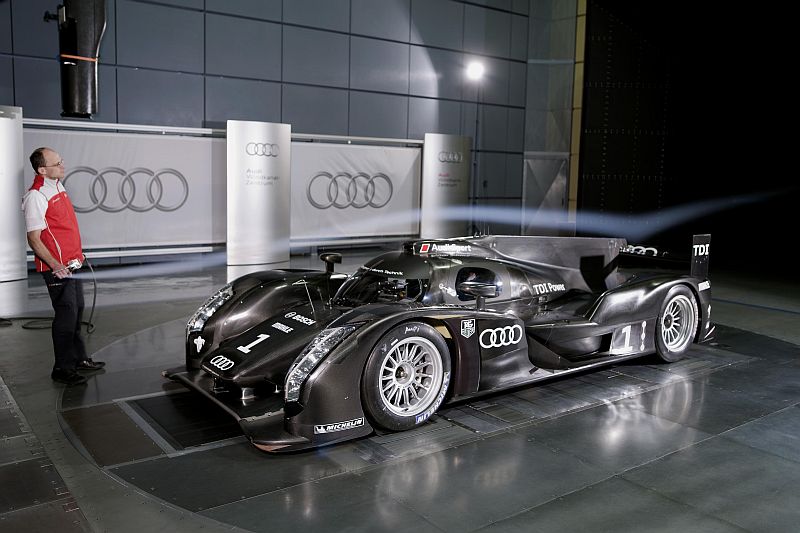
2011 Audi R18 Race supercar


Having succeeded with the R8, R10 TDI and R15 TDI models as the world’s most important endurance race car as many as nine times, Audi is aiming for its tenth Le Mans success in 2011 with its R18 Racecar. Audi is planning to field three Audi R18 cars at Le Mans, which will be entered by Audi Sport Team Joest, the most successful Le Mans team of all time.

Through the innovative V6 TDI engine for the Le Mans 24 Hours, motorsport is yet again performing pioneering work for the production arm at Audi where there is a growing trend towards smaller, more economical but yet powerful engines. Another new development is the six-speed transmission in the R18 which has been specifically modified for use with the smaller engine.
The R18 benefits from the chassis and aerodynamics package containing a lot of know-how from the R8, the R10 TDI and the R15 TDI whereas the fitting of identically sized front and rear wheels is new to an Audi Le Mans sports car. This configuration allows a more balanced weight distribution.
The R18’s headlights, which are the first to completely consist of LEDs with optimized amount of light, are a technical highlight. The new generation of headlights was developed in close cooperation between Audi Sport and the Technical Development (TE) division of AUDI AG and by using at Le Mans, will be prepared for future use in production vehicles.

2011 Porsche 911 GT3 RSR


2011 Porsche 911 GT3 RSR
The Porsche 911 GT3 RSR takes off into the new motorsport season with extensive modifications. The 2011 version of the world’s most successful GT race car celebrated its international premiere at the “Night of Champions” party held at the R&D Centre in Weissach to mark the end of the motorsport season. Priority in the further development of the GT3 RSR was given to the newly designed aerodynamics at the front and rear, changes to the suspension kinematics and to the engine.

The 4.0-litre, six-cylinder boxer engine now delivers 455 hp (355 kW) at 7,800 revs, five horsepower more than its predecessor. The power increase results from an engine management system which adapts even better to different fuel grades, as well as a redesigned exhaust system and a modified air intake housing. Moreover, the driveability of the famously efficient engine has undergone further improvements. Maximum revs remain unchanged at 9,400 rpm.

Clearly visible are the modifications to the front. A new front lip provides higher downforce at the front axle. The front wheels are now wider with the rims growing from 11 to 12 inches giving additional grip and less of an understeering tendency. The position of the rear wing and the shape of the wing mounting also underwent optimisation and were adapted to the new rear fairing with additional air outlet louvers. The rear lid was also redesigned for optimised air ducting. Like the 911 GT3 Cup and the GT3 R, the RSR has now been equipped with the LED rear lights taken from the latest 911 road-legal cars.

The 911 GT3 RSR joins the 911 GT3 R and the 911 GT3 Cup as the top model of Porsche Motorsport’s product range. The successful long distance racer from Weissach can be ordered now at a price of 410,000 Euro plus country-specific value added tax. All 2011 modifications are available as a kit for GT3 RSR cars from the 2010 season.

Porsche Carrera GT new edition

Porsche Carrera GT
Released at the 2003 Geneva Auto Show, Porsche's Carrera GT was a final production version of the concept car first seen at the 2001 Paris Auto Salon. It was Porsche's first limited production supercar since 959 production stopped in 1988. At the time of launch, it was one of the few available products that rivaled the Ferrari Enzo.

Unlike the 911, which carried the company for four decades, the Carrera GT was complete bottom up design. Its styling was thankfully unchanged from Paris show car and departed from the traditional Porsche shape which the 959 couldn't escape.

Motivation for the Carrera GT came directly from Porsche's successful motor sports program and the Porsche WSC-95 Le Mans prototype. After winning Le Mans twice in 1996 and 1997, Porsche revived an old V10 engine for the 1999 season but it was shelved only two days into track testing. Fortunately, the 5.5 liter V10 was used in a one-of 2001 Paris Auto Salon concept car which was received well enough for production to begin two years later. Final Assembly commenced at Porsche's Leipzig plant and the car sold with an MSRP of $440,000 USD, $515,000 CAD, or €390,000.

Under the skin, the car used many modern hallmarks of motor sport engineering: a carbon fiber chassis, dry sump lubrication, inboard suspension and a mid-mounted engine that was engineered to sit as low as possible to ground. Careful attention was also paid to under tray airflow which could be managed better than the rear-engine 911.

A new V10

Porsche's V10 engine can trace its roots back to a unit developed in secret by Porsche for the Footwork Formula One team. This development halted in 1992, but was resurrected for a WSC-95 successor that was never completed. Bored out to 5.5 liters, this unit then found its way into the Carrera GT Prototype. When production commenced, it was modified by Porsche engineers to ensure more power and reliability. Such revisions included a larger displacement which offered more torque and driveability.

This engine is placed in the middle of the chassis in a three-point carbon subframe. This is unlike Paris Show Car which featured its V10 as a load bearing structure within the chassis. Had Porsche not used a subframe, noise leakage and vibration would have hampered interior comfort.
The intake system is equipped with Porsche's VarioCam technology found on the current 996 range. VarioCam continuously adjusts the angle of the intake camshaft to optimize performance and output.
Making the engine as light as possible was a primary goal. A light alloy crankcase and titanium connecting rods help the engine have a weight of 452 lbs (205 kg). Compare this to the Enzo's V12 weighing in at 496 lbs (225 kg).

6-Speed with a Ceramic Clutch

Power is transferred to the rear wheels through a newly developed six-speed manual transmission. Attached is a special clutch which has a reduced size and weight. Called Porsche Ceramic Composite Clutch (PCCC), this two-plate clutch is made of ceramic composites. Such materials not only help reduce the rotational masses of the clutch by a factor of ten, but offer less wear than conventional material. Combined with a lightweight flywheel, rotational mass of the engine is exceptionally light.

Another highlight of this clutch is its short diameter of only 6.5 inches (165 mm). At such a height, the transmission and engine are very short and mounted low in the chassis. Just how low? Well the crankshaft rotates just 4.0 inches (102 mm) from the floor and the transmission actually sits lower than the rear differential.

CFP Chassis

Providing a basis for the Carrera GT is a carbon fiber monocoque with carbon-fiber-reinforced plastic (CFP) sub frames. Among the carbon body and carbon frame, metal pieces are few and far between. For instance on the chassis, the front rails, a-post inserts, fuel cell and suspension are the only major non-carbon elements.

The chassis is manufactured by the ATR Composites Group. They are specialist Italian carbon fiber manufacturer which coincidentally make the tubs for the Ferrari Enzo. Production at ATR is two complete chassis per day.

A carbon rear sub frame isolates the entire drive train and rear suspension from the chassis. Having the engine completely supported CFP materials is new concept to production car manufacturing. It was concept developed by Porsche's Motor Racing Division and is subject to patent.
Suspension elements include double wishbones with inboard damper and springs on all four wheels. The inboard dampers and springs are actuated by pushrod and dampers like the setup used by every Formula One constructor.

Braking on all four corners is executed by the capable Porsche Ceramic Composite Brake (PCCB) system and for the first time on fifteen inch rotors. Consisting of ceramic discs and composite pads, the system is lightweight and resistant to corrosion. PCCB reduces the unsprung weight of the braking system by fifty percent. Four channel ABS comes standard.

Attached to the braking system are forged magnesium wheels which weigh less than the tires wrapped around them. Michelin makes the only tire approved for the Carerra GT. They feature a soft compound rubber on the outer one third of the tread. It is suggested by Porsche that these tires need replacement every 15000 miles.

Aerodynamics

A large rear wing provides down force at the rear of the car. As the car reaches 75 mph (120 km/h) it electro-hydraulically raises an additional 6 inches (16 cm) for increased stability. At top speed the combined down force of the front and rear wheels total 639 pounds (290 kgs).

Apart from the wing, most of the Carrera GT's down force comes from its under tray. The entire tray is manufactured from carbon fiber and is attached to the chassis, engine mounts and crash structure. Creating down force with such a device is efficient as it does not impair the car's drag coefficient. A diffuser and air flow ducts provide additional ground effect.

Further aerodynamic attention is applied to the lower wishbones. They are made of efficiently shaped steel tubes which do not interfere with the aerodynamics underneath the car.

Electronics

To ensure control under all situations, the Carrera GT has a four channel anti-lock braking system and anti-spin control (ASC) to prevent excessive wheel spin. Traction control is standard. 'Should he/she wish to enjoy the thrill of dynamic driving of the highest racing standard the driver can switch off the complete traction control function by pressing a button in the centre console.' says Porsche.

Comfort

Porsche describe the Carrera's clean interior as a function-oriented ambience and a cockpit free of all extraneous detail. Only high-tech materials such as carbon, magnesium and leather adorn most surfaces.

Information is clearly presented in a classic Porsche instrument cluster which replaces the LCD screen featured on the concept car. The car also uses the 911 steering wheel which doesn't follow the F1 trend to stick as many functions on the wheel as possible. This old-school approach is a refreshing change, contributing to the GT's ambiance and ensuring it will remain a timeless design.
Extending into the dash is a centre console covered in magnesium. Attached sits a birch/ash shifter which is the only piece of wood found in this carbon-laden car. It specifically pays homage to Porsche's 917 which sported a balsa-wood gear lever. Balsa was the optimum material for the job, it was extremely light, but most importantly added to the character of the 917.

Amenities such a Bose stereo system and air conditioning are optionally offered.

For closed top driving, two carbon fiber panels can be attached to the roof. At a low weight of just 6.4 lbs (2.4 kgs) each, these panels are easily removable and can be stored in the front luggage compartment.

Enzo vs Carrera

Comparison between the Carrera GT and Ferrari Enzo is inevitable. Both entered the market at the top of the product range and both place heavy emphasis on driver-oriented driving, but each executes this philosophy in a different way.

Where the Enzo has three driving modes, and a huge bevy of electronic systems, the Carrera is stripped down to basic performance. This is largely due to the fact that the Carrera only has a 6-Speed Manual whereas the Enzo is equipped with a paddle-shift, computer controlled, 6-speed sequential. Getting back to basics is somewhat cheaper, since the Carrera GT was $444,400 when new compared to the $660 000 USD Enzo.

With regards to pure performance, the Enzo does have 48 more horsepower (35.8 kW), and weighs 33 lbs (15 kgs) less which would make it win on any straight. The Carrera GT on the other hand, offers much more down force and might possibly catch up in the turns. In any case, if either car is superior, the margin is so narrow that it's more a question of driver skill.

Conclusion

Despite announcing a total production of 1500 units, only 1270 came from the factory in Saxony. Porsche stopped after airbag regulations changed in the US. It is also important to mention that the Carrera GT wasn't meant to become the fastest road legal supercar. Had Porsche tried to chase the McLaren's performance figures, production (planned at 1500 cars), profitability and comfort would have suffered.

Most cars came in the standard colors of Guards Red, Fayence Yellow, Basalt Black, GT Silver or Seal Grey, but custom colors were available.

Sources & Further Reading

Davis, Matt. 'Porsche Carrera GT'. Octane, December 2003.
Harris, Chris. 'The Dazzling Carrera'. Autocar, September 2003.
Kacher, Georg. 'The Porsche We've All Been Waiting For'. CAR.
Meaden, Richard. 'Super Ferry Animal'. EVO, November 2003.
Simister, John. 'Gunning for Enzo'. EVO.
Stout, Pete. 'Porsche's Pinnacle'. Excellence, December 2003.

Story by Richard Owen for Supercars.net

Porsche Greenlights 918 Hybrid Supercar

It’s official: Porsche will build the 918 hybrid supercar.

The company’s board approved the project earlier today based upon “overwhelming response from the public and customers.” Those same customers must have very deep pockets, because the last we heard the Porsche 918 will cost something north of $600,000.

Be that as it may, it promises to be a sweet car.

The concept that Porsche unveiled earlier this year at the Geneva Motor Show raised a whole lotta eyebrows, and why wouldn’t it? Porsche promises exceptional performance along with stellar fuel economy and emissions.

We say “promises” because the car’s performance specs come from Porsche and, so far as we know, haven’t been independently verified. Porsche says the 918 will do zero to 100 km/hr in less than 3.2 seconds and hit a top speed of 198 mph. All that while emitting just 70 g/km of CO2 and consuming 3.0 liters per 100 kilometers. That works out to 78.4 mpg if our math is correct.

Porsche hasn’t said how it arrived at those emissions or fuel economy figures, but we’re betting that achieving them will require the very lightest touch on the accelerator and maximum electrical assistance.

The mid-engined roadster features a 500-horsepower V8 based upon the 3.4-liter mill found in the Porsche RS Spyder race cars. It’s also got a pair of electric motors; together they put down 218 horsepower. The car has four modes that range from full electric to “race,” which throws efficiency to the wind and uses the electric motors as a push-to-pass feature. (You can get more on the tech in this post.)

Porsche’s supervisory board directed its minions to “develop a production model based on the car already presented,” so the car we’ll see will bear at least some resemblance to what we saw in Geneva. It almost certainly will be a super limited edition model like the Carerra GT.

Still, there are at least 1,000 people out there interested in buying one, because that’s how many “hand-raisers” Porsche said it wanted to see before deciding whether to build the car.

Photo: Porsche

See Also:

    * Porsche 918 Spyder: The $630K Hybrid
    * Peek Inside Porsche’s Super Hybrids
    * 500-Horsepower Plug-In Porsche Makes Us Swoon
    * Video: Porsche’s Hybrid Racer Runs the ‘Ring
    * Hybrid Porsche Racer Makes the Podium